

Maximize Your Forex Gains with the Pyramid Forex Trading Strategy
Forex trading, a dynamic and potentially lucrative financial market, offers various strategies for traders to capitalize on currency fluctuations. Among these, the Pyramid Forex Trading Strategy stands out as a sophisticated technique designed for maximizing profits. This strategy leverages the concept of compounding, where traders intensify their market positions as favorable trends develop, aiming to amplify gains while meticulously managing risks. This article delves into the intricacies of this strategy, providing a comprehensive guide for those seeking to enhance their trading acumen. This is a riskier strategy, many may first need beginner-friendly forex guide.
Key Concepts
- Pyramid Trading Essentials: A technique focusing on adding larger positions to a winning trade, leveraging market trends for maximum profit.
- Strategy Mechanics: Involves identifying strong trends using technical analysis, starting with a small position, and progressively increasing trade sizes.
- Risk Management and Rules: Emphasizes disciplined risk management, including strategic stop-loss adjustments and adherence to strict trading rules for success.
- Advantages and Challenges: Offers significant profit potential through compounding returns, yet requires experience and thorough understanding of market dynamics.
Understanding the Pyramid Forex Trading Strategy
At its core, the Pyramid Forex Trading Strategy involves adding to a position in increments as the market moves in your favor. This method contrasts sharply with “averaging down,” a technique where traders increase their position size as the market moves against them. In pyramiding, the emphasis is on riding winning trends by reinvesting profits from successful trades.
Maximizing Profits through Compounding
The beauty of the Pyramid Forex Trading Strategy lies in its ability to compound profits. As a position becomes increasingly profitable, additional trades are executed, each larger than the last. This compounding effect can exponentially increase gains without proportionally increasing risk. By only adding to profitable positions, the strategy ensures that each new trade is funded by the successes of previous ones, thereby maximizing the potential for profit while keeping a tight rein on risks.
Distinguishing Pyramiding from Averaging Down
A common misconception is equating pyramiding with averaging down. Unlike averaging down, where traders add to losing positions, potentially compounding losses, pyramiding is a more calculated and risk-aware approach. It focuses solely on enhancing winning positions, using the profits of earlier trades to support new ones. This approach not only preserves capital but also aligns with the fundamental principle of cutting losses short and letting winners run.
The Pyramid Forex Trading Strategy is a testament to the importance of disciplined and strategic trading in the Forex market. It underscores the need for traders to adapt to market conditions, seizing opportunities presented by strong trends while remaining vigilant about potential shifts in market dynamics.
Mechanics of Pyramid Trading
Understanding the mechanics of Pyramid Trading is crucial for its successful application. This strategy hinges on identifying a strong trend using technical analysis tools like moving averages and momentum indicators. Initially, a small position is opened in the direction of the trend. This conservative start is essential as it allows traders to test the waters without committing substantial capital.
As the trend continues, the trader adds to this winning position. The size of each subsequent trade is larger than the previous, capitalizing on the compounding effect. This approach contrasts starkly with more traditional methods where a single large position is taken at the outset. By incrementally increasing the position size, Pyramid Trading amplifies potential returns while simultaneously providing a cushion against market volatility.
Executing the Strategy Effectively
Key Rules for Successful Pyramiding
To effectively execute the Pyramid Forex Trading Strategy, traders must adhere to certain rules. The market must be in a strong trend – either an uptrend for buying positions or a downtrend for selling. Accurate identification of these trends is the cornerstone of successful pyramiding. Traders should also wait for the market to retest resistance or support levels before adding to a position. This retesting confirms the trend’s strength and the likelihood of continued movement in the desired direction.
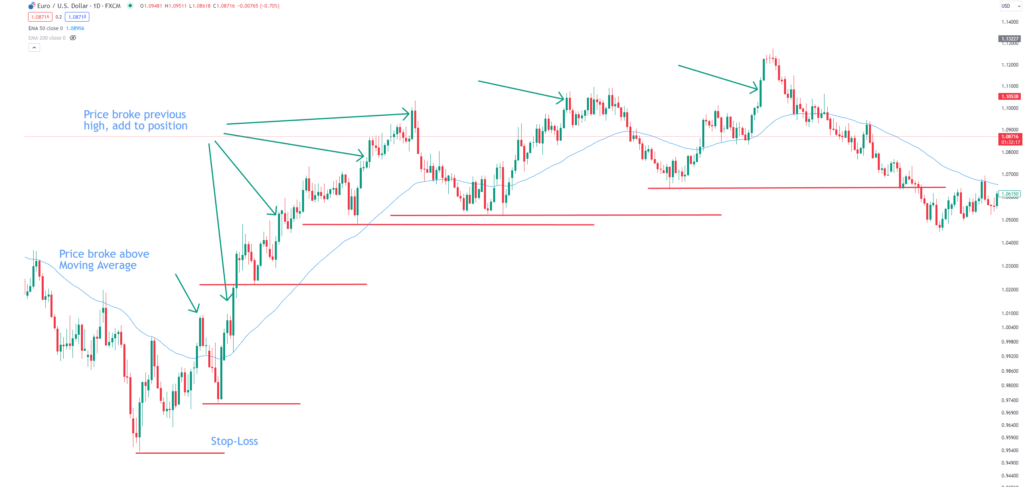
Once a position is taken, it’s crucial to let it run, especially in a strong trend. As the price breaks through subsequent resistance or support levels, additional positions can be added, each time adjusting the stop loss to protect accumulated profits. This method of managing risk is vital as it prevents the erosion of gains from earlier successful trades. Consistently trailing stop losses behind new positions helps in locking in profits and minimizing potential losses.
Examples of Successful Pyramid Trades
Illustrating the strategy with real-world examples can be immensely helpful. For instance, consider a scenario where a trader identifies a strong uptrend in EUR/USD. The trader initially buys a small position. As the trend continues and EUR/USD breaks and retests subsequent resistance levels, the trader adds to the position, each time moving the stop loss to a level that locks in profits from earlier trades.
This calculated approach allows the trader to maximize profits from the strong trend while maintaining control over potential risks. Each additional position compounds the profit potential, aligning with the primary goal of the Pyramid Trading Strategy.
Advantages of Pyramid Trading
One of the primary advantages of the Pyramid Forex Trading Strategy is the compounding of returns. As the trend continues and additional positions are added, each trade, larger than the last, significantly boosts potential profits. This strategy exemplifies the concept of “letting winners run,” allowing traders to maximize gains from strong market trends.
Another advantage is adaptability. Pyramid Trading can be applied across various market conditions and currency pairs, offering traders a versatile tool in their trading arsenal. This flexibility is particularly beneficial in the Forex market, where currency pair behaviors can vary widely.
Risks of Pyramid Trading
Despite its advantages, Pyramid Trading is not without risks. The strategy involves assuming a larger position as the trend continues, which can lead to substantial losses if the market reverses unexpectedly. Such scenarios highlight the importance of having a well-defined exit strategy and the discipline to adhere to it.
The complexity of the strategy also means it requires a higher level of experience and understanding of technical analysis and market trends. Novice traders might find the multiple position management and risk assessment aspects challenging, increasing the risk of missteps.
Frequently Asked Questions (FAQs)
1. Can Pyramid Trading be applied to all market conditions? (150 words) Pyramid Trading is most effective in strong trending markets. It relies on the ability to identify and capitalize on persistent market trends. In choppy or range-bound markets, where clear trends are absent, this strategy may not be as effective. It’s crucial for traders to accurately assess market conditions before applying Pyramid Trading to ensure its suitability and to maximize the probability of success.
2. What is the key difference between Pyramid Trading and Averaging Down? (150 words) The key difference lies in the approach to position sizing in response to market movements. Pyramid Trading involves adding to a position as it becomes profitable, thereby compounding gains. In contrast, averaging down involves increasing position size as the market moves against you, thereby reducing the average entry price but potentially increasing overall risk. Pyramiding capitalizes on winning trends, whereas averaging down is often seen as a way to ‘rescue’ losing positions.
3. How does Pyramid Trading manage risk while compounding profits? (150 words) Pyramid Trading manages risk through strategic position sizing and stop-loss adjustments. By only adding to a position when it shows a profit, the strategy limits exposure to losing trades. Trailing stop losses are used to protect accumulated gains and minimize losses. This approach ensures that even as position sizes increase, risk is controlled, and profits from earlier trades help buffer potential losses from newer positions.
