Types of Forex Trading Strategies: A Full Guide for Traders
Introduction to Forex Trading Strategies
In the dynamic world of Forex trading, a global marketplace for exchanging national currencies, understanding the types of Forex trading strategies is crucial for every trader. This market, one of the largest and most active globally, is characterized by its volatility and the ongoing potential for profit. Selecting the right Forex trading strategy, which aligns with individual trading styles, risk tolerance, and financial goals, is essential for achieving success in this arena.
Forex trading strategies encompass a broad spectrum in terms of frequency, time frames, and methodological approaches. Ranging from rapid, short-term tactics like scalping to more measured, long-term approaches such as positional trading, these strategies offer diverse avenues for traders. Gaining insight into the nuances of each strategy equips traders with the knowledge to make informed decisions that resonate with their unique market perspectives and personal preferences. You can learn more about Forex and Forex strategies on our strategies page.
Scalping Strategy
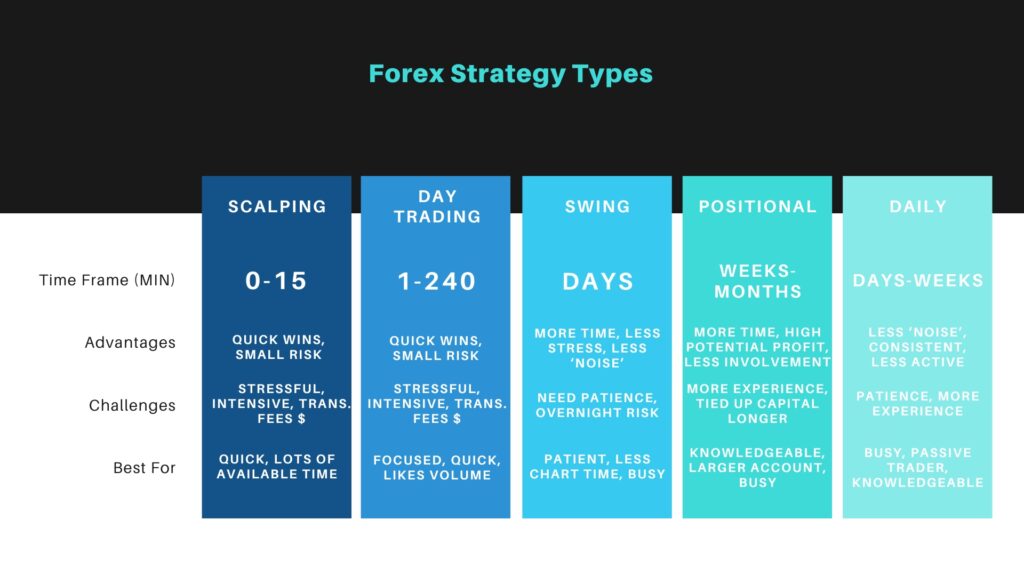
Scalping is a popular Forex trading strategy known for its fast-paced nature and frequent trades. Scalpers aim to capture small price gaps created by bid-ask spreads or price fluctuations. This strategy is ideal for traders who prefer short-term trades and can make quick decisions. Scalping involves holding positions for a few minutes, sometimes even seconds, making it one of the most intense trading strategies.
Overview and Approach
- Time Frame: Trades last from a few seconds to several minutes.
- Frequency: High number of trades within a day.
- Profit Goals: Small, with scalpers targeting changes in pips (the smallest price move that a given exchange rate can make).
- Chart Analysis: Primarily relies on low time-frame charts for precision.
Advantages and Challenges
- Advantages:
- Quick profits: Small gains can accumulate to significant amounts.
- Limited market exposure: Reduced risk from market fluctuations due to short holding periods.
- Challenges:
- High stress and demands constant attention.
- Costly in terms of transaction fees due to the high number of trades.
Suitable for Whom
Scalping is best suited for traders who can dedicate time to constantly monitor the market, make quick decisions, and feel comfortable with high-frequency trading. It’s less suitable for those who prefer analyzing longer-term market trends or cannot commit to the intense nature of this strategy.
Day Trading Strategy
Day trading is a strategy where traders enter and exit positions within the same trading day. This approach is designed to avoid the risk of significant overnight price movements. Day trading is popular among beginners due to its relatively straightforward concept and the potential to quickly realize profits.
Overview and Approach
- Time Frame: Trades last from a few hours to an entire trading day.
- Chart Analysis: Traders often use one and up to thirty-minutes time bars for analysis.
- Profit Goals: Vary depending on the trader’s approach and market conditions.
Advantages and Challenges
- Advantages:
- Reduced risk from overnight market changes.
- Opportunities for quick profits.
- Challenges:
- Requires constant market monitoring.
- Can be stressful and demanding, needing quick decision-making.
Ideal Trader Profile
Day trading is ideal for individuals who can dedicate a full day to trading, make quick decisions, and are comfortable with the possibility of making several trades in a day. It’s less suitable for those who cannot commit full-time hours or prefer a less intensive trading approach.
Swing Trading Strategy
Swing trading involves holding positions for several days, aiming to profit from short-term price patterns. This strategy is a blend of day trading and positional trading, offering a moderate approach to Forex trading.
Overview and Approach
- Time Frame: Trades are held for several days.
- Chart Analysis: Typically involves half-hour to hourly bars.
- Profit Goals: Moderate, aiming to capture significant short-term price moves.
Advantages and Challenges
- Advantages:
- More time for decision-making compared to day trading.
- Reduced stress and lower trading frequency.
- Challenges:
- Requires patience and the ability to predict short-term market trends.
- Risk of overnight market changes affecting positions.
Target Trader Demographic
Swing trading is best for traders who prefer a balance between the fast-paced nature of day trading and the long-term approach of positional trading. It’s suitable for those who can patiently wait for the right trading conditions and can analyze market trends effectively.
Positional Trading Strategy
Positional trading is a long-term approach to Forex trading. It focuses on maximizing profits from major shifts in prices, often ignoring short-term market fluctuations. This strategy requires a deep understanding of market fundamentals and a high level of patience.
Overview and Approach
- Time Frame: Trades can last from several weeks to months.
- Chart Analysis: Primarily relies on end-of-day charts.
- Profit Goals: Large, with a focus on capturing major market moves.
Advantages and Challenges
- Advantages:
- Less time-consuming on a day-to-day basis.
- Potential for significant profits from large market shifts.
- Challenges:
- Requires extensive market knowledge and analysis skills.
- Longer holding periods mean capital is tied up for more extended periods.
Appropriate for Which Traders
Positional trading is ideal for traders with a good grasp of market fundamentals and trends, who prefer less frequent, more substantial trades. It’s less suited for those looking for quick profits or who are uncomfortable with holding positions for extended periods.
50-Pips a Day Strategy
The 50-pips a day Forex strategy is a method focusing on capturing an early move of highly liquid currency pairs, like GBPUSD and EURUSD. It is a form of day trading strategy that targets a set profit of 50 pips.
Overview and Approach
- Approach: Entails setting two opposite pending orders after the 7am GMT candlestick closes. One order is activated by price movement, and the other is automatically canceled.
- Risk Management: Involves placing a stop-loss order to manage potential losses effectively.
Advantages and Challenges
- Advantages:
- Clear profit target makes it easy to implement.
- Suitable for those who can monitor the market during specific hours.
- Challenges:
- Requires precise timing and fast execution.
- Limited to specific currency pairs and times.
Who Should Use It
This strategy is best for traders who prefer a structured approach with a clear profit goal and can trade during specific hours. It’s less suitable for traders who prefer more flexibility or are not able to trade during the early hours.
Daily Chart Strategy
The Daily Chart Strategy involves using daily charts to identify trading setups. This method is favored by many traders for its potential to yield significant profits through larger time frame analysis.
Overview and Approach
- Time Frame: Based on daily chart analysis.
- Chart Analysis: Focuses on identifying long-term trends and major market movements.
- Profit Goals: Aiming for substantial profits over longer periods.
Advantages and Challenges
- Advantages:
- Less market noise and more reliable signals compared to shorter time frames.
- Reduced need to constantly monitor the market.
- Challenges:
- Requires patience and a longer-term market view.
- May involve longer periods without trading opportunities.
Ideal User Profile
The Daily Chart Strategy is ideal for traders who prefer analyzing broader market trends and are patient enough to wait for high-probability setups. It’s less suitable for those looking for quick trades or who enjoy frequent market interaction.
Forex 1-Hour Trading Strategy
The Forex 1-Hour Trading Strategy is a more short-term approach than the daily chart strategy, utilizing the 60-minute time frame to identify trading opportunities.
Overview and Approach
- Time Frame: 1-hour charts are used for this strategy.
- Technical Indicators: Commonly employs tools like the Moving Average Convergence Divergence (MACD).
- Profit Goals: Moderate, targeting short-term price movements.
Advantages and Challenges
- Advantages:
- Balances between long-term and ultra-short-term strategies.
- Suitable for traders who can dedicate a few hours a day.
- Challenges:
- Requires constant market monitoring during trading sessions.
- May involve higher transaction costs due to increased trade frequency.
Target Audience
This strategy is well-suited for traders who are looking for more action than what a daily chart offers but less intensity than scalping or day trading. It’s ideal for those with the ability to analyze and react to faster-paced market changes.
Frequently Asked Questions
Q: What Determines the Success of a Forex Trading Strategy?
The success of a Forex trading strategy depends on various factors including the trader’s understanding of the market, risk management skills, adherence to the strategy, and the ability to adapt to changing market conditions. Emotional discipline and consistent execution also play crucial roles.
Q: Can Beginners Successfully Implement Advanced Forex Strategies?
While beginners can learn advanced Forex strategies, it’s generally recommended to start with simpler strategies and gradually progress to more complex ones. This progression helps in building a solid understanding of market dynamics and risk management principles.
Q: How Important is Risk Management in Forex Trading Strategies?
Risk management is critical in Forex trading. It involves setting appropriate stop-loss orders, managing position sizes, and understanding leverage. Effective risk management can help in preserving capital and sustaining a long-term trading career.
Q: Should a Trader Stick to One Strategy or Try Multiple Strategies?
It depends on the trader’s objectives and market conditions. Some traders find success in mastering one strategy, while others benefit from applying multiple strategies. Flexibility and the ability to adapt to different market scenarios can be advantageous. It is advised, however, to master one strategy before moving on and adding more strategies to your portfolio.
Q: How Do Economic Events Affect Forex Trading Strategies?
Economic events like interest rate decisions, employment reports, and political events can cause significant market volatility. Traders need to be aware of such events as they can affect currency values and may require adjustments in trading strategies.